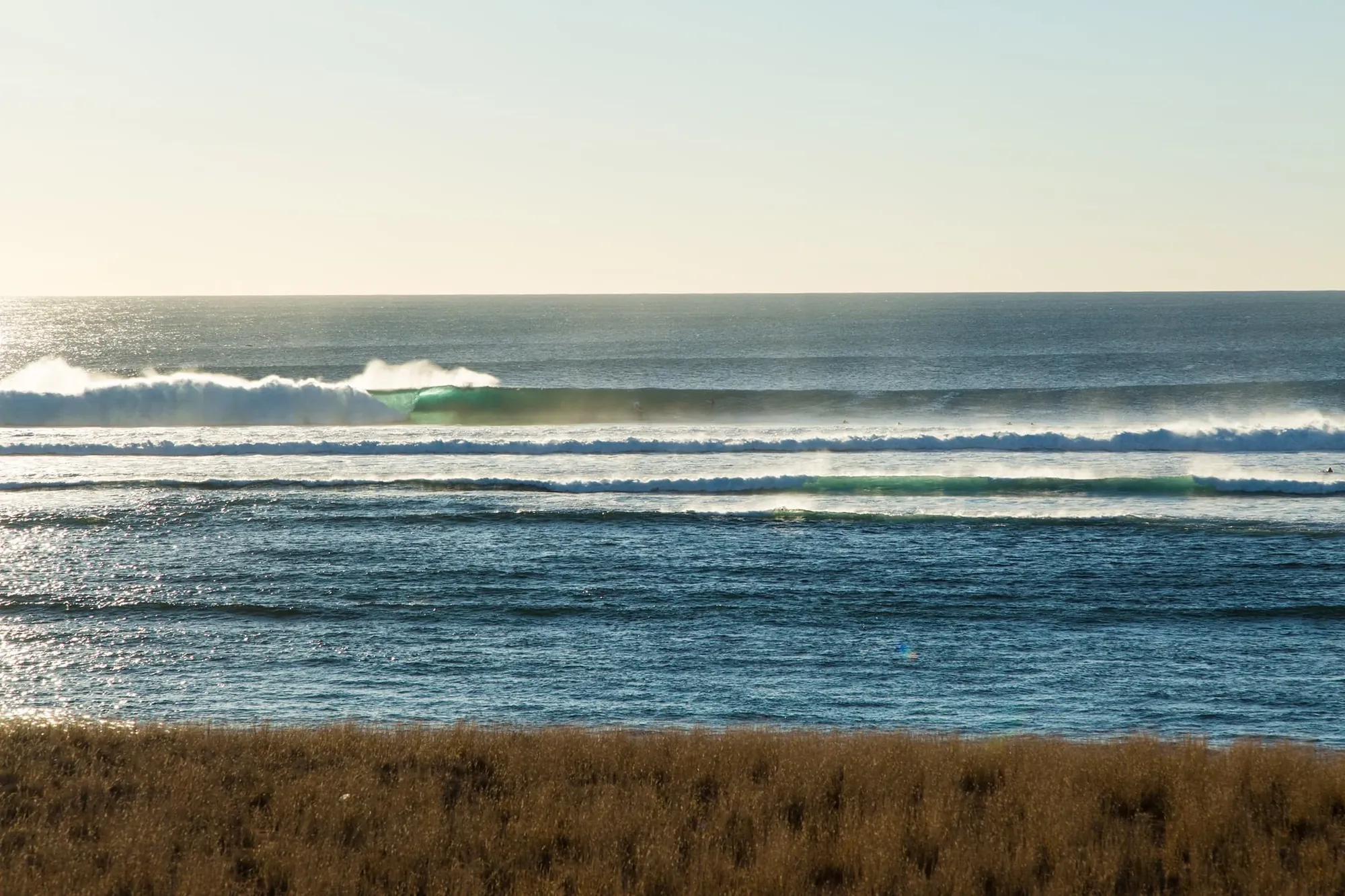
Journal · Ocean & wellbeing
Why the ocean calms your brain: sound, attention and awe
Why does the ocean calm you? The research points towards sound, attention and awe, though it very rarely points at the ocean itself.
Slide into a brain scanner and listen to a sound that could be surf or could be traffic. Look at a photograph of a beach and it feels tranquil. Swap the beach for a motorway, leave the soundtrack exactly as it was, and your brain responds differently.
Hunter and colleagues ran that experiment in 2010. Why does the ocean calm you? Part of the answer, it seems, is what you believe you are listening to.
The short answer. Nobody has pinned down exactly why the sea settles people. Natural sounds, water scenes and awe are each linked with feeling better or recovering faster from stress, but most of the studies used fountains, photographs, forests or videos. The link looks real and the evidence for it is modest. The sea may help you feel better; it is not a treatment for a mental health condition.
Sound
Why does the ocean calm you? Start with what you can hear
The most useful synthesis of natural sound we found is a 2021 review in PNAS, in which Buxton and colleagues gathered 36 publications and meta-analysed 18 of them. Natural sounds were associated with lower stress and annoyance, and with better health and positive mood. Water sounds had the largest average effect on health and positive mood, which surfers will enjoy hearing. Birdsong did best on stress and annoyance, which they may not.
Two caveats. The intervals were wide: water’s effect size could plausibly have been anywhere from 0.35 to 3.67. And “water” in that review means water in general, which is some distance from a clean set rolling through at low tide.
Look closely at the experiments and the sea keeps failing to turn up. In a 2010 lab study, Alvarsson’s team stressed 40 volunteers with a maths task, then played them nature sound or noise. Skin conductance tended to recover faster during the nature sound, and heart rate variability showed no effect. The nature sound was a fountain with tweeting birds.
Gould van Praag and colleagues scanned 17 healthy volunteers, average age 26, in 2017. Natural soundscapes did not raise activity in the default mode network, a set of brain regions tied to self-focused thinking, compared with artificial sounds, but connectivity within that network shifted from front to back, and a heart rate measure pointed to more “rest and digest” activity. Responses varied with each person’s baseline, the sample was tiny, and the sounds were not specific to the ocean. A 2013 pilot by Annerstedt’s group pointed the same way: after a virtual stress test, parasympathetic activation appeared only in people given a virtual forest with nature sounds, and not in those given a silent one.
We could find no well-controlled trial that played real recorded surf to healthy adults and measured their stress. The defensible position is that water sounds look promising, and that context counts. Hunter’s beach and motorway experiment suggests that what you think you are hearing, and where, shapes the response.
Attention
Does looking at the sea restore your attention?
Attention restoration theory holds, in broad terms, that time in natural settings gives a tired mind a chance to recover. It is influential, and only partly supported.
When Ohly and colleagues reviewed 31 studies in 2016, just three measures showed a significant benefit: two digit-span tests and one trail-making test. The other ten meta-analyses showed no marked gain. A 2018 update by Stevenson’s team, covering 42 articles, was kinder. Working memory and cognitive flexibility improved after time in nature, with low to moderate effects. Attentional control, awkwardly for a theory with attention in its name, improved less reliably.
The companion idea, stress reduction theory, draws on experiments such as Ulrich’s from 1991. The team showed 120 undergraduates a 10-minute film about workplace accidents, then a 10-minute video of one of six settings, two natural and four urban. Physiological recovery was faster and more complete with nature. Water, in the form of a fast-moving stream, was one of the two natural settings, but the authors found no general difference between it and vegetation and pooled the two, so the headline result is not about water alone.
Water does win on looks. In 2010, White and colleagues had people rate 120 photographs, half containing water, with the proportions of water, greenery and buildings standardised. Water scenes scored higher for preference, positive mood and how restorative they seemed. One measure was what people would pay for a hotel room with that view, a research method hoteliers will appreciate. This is evidence about perception, from photographs, and it says nothing about health.
Even a pretend sea has some pull. Yeo’s team deliberately bored 96 adults in 2020, then showed them a virtual coral reef on a TV or in virtual reality, with the BBC’s Blue Planet II team helping to match the content. Every format reduced boredom and negative mood, though the study had no non-nature comparison.
Neither of the big reviews isolates the ocean or surfing, and we found no attention-restoration trial specific to the sea. What happens once you stop looking at waves and start riding them is a separate subject, picked apart in why surfing feels so good.
Awe
Awe and mental health: the science of feeling small
The neatest awe experiment involves nothing more demanding than a stroll. In 2022, Sturm and colleagues randomised 60 healthy older adults to weekly 15-minute walks for eight weeks, either focused on awe or not. The awe walkers felt more awe and reported less daily distress. In their own photographs they gradually took up less of the frame, a growing “small self”, while smiling more intensely. Scores for anxiety, depression and life satisfaction did not change in either group, and the volunteers were a good deal older than the average line-up.
Feeling small may also make people nicer. Across five studies and 2,078 people, Piff’s team found that awe predicted or increased generosity, ethical decisions and helping, partly through that smaller sense of self. In the final study, standing among towering eucalyptus trees increased helping and reduced entitlement. Whether this extends to a crowded point on a Saturday morning remains, sadly, untested.
Other findings need a firmer hand on the brake. Stellar and colleagues reported in two correlational studies that, of the positive emotions they tested, awe was the strongest predictor of lower interleukin-6, an inflammatory marker. That does not show awe lowers inflammation. Anderson’s 2018 research with veterans and young people from underserved communities found that awe during whitewater rafting, more than other positive emotions, predicted changes in wellbeing and stress-related symptoms a week later.
Then there is van Elk’s 2019 scanner study, in which 32 healthy people watched awe videos and showed less engagement of default mode regions, consistent with less self-focused thinking. It is tempting to staple that to the sound study above and announce that the ocean quietens the default mode network. No study here shows that. One found no rise in activity with natural sounds, only changes in connectivity, and the other involved videos in a scanner.
Our own inference, and it is only an inference: a big swell marching in from the horizon seems a likely source of awe. None of these studies tested the sea or surfing, and we found no study that measured awe during a surf.
Blue space
Is the sea good for your mental health?
Our earlier piece, How the sea helps people, covers the coastal-living and 120-minute studies, so those findings can stay there. The question here is what wider reviews and controlled experiments add.
Gascon and colleagues reviewed 35 studies in 2017. On balance, more exposure to blue space was associated with better mental health and wellbeing, and with more physical activity. Results for general health, obesity and cardiovascular outcomes were less consistent. Association is the key word, because much of this field is observational.
For cause and effect you want a trial, and Vert’s 2020 randomised crossover study is a tidy one. Fifty-nine healthy office workers took 20-minute sessions of blue-space walking, urban walking and rest. Wellbeing and mood improved straight afterwards with the blue-space walk compared with the other two, while the cardiovascular results showed no advantage over walking through town.
Surf therapy
Does surf therapy work? What the reviews say
Surf therapy has moving stories behind it and a limited evidence base. The strictest assessment we found is Carneiro and colleagues’ 2024 systematic review of controlled trials for people with mental health disorders, although only one of the trials it included required a formal diagnosis. From 5,666 records, only three randomised trials qualified. Against wait-list or hiking comparisons, the authors found no solid, consistent sign of symptom improvement, rated their certainty as very low and judged every trial at high risk of bias.
Broader reviews are warmer and still cautious. Britton’s 2020 review of 33 studies of “blue care” programmes, surfing among them, mostly found positive or weak associations with mental health and psychosocial wellbeing, with mixed results for social connection. Benninger’s 2020 scoping review of 29 studies was supportive overall while noting that the evidence needs strengthening.
A 2023 trial by Walter and colleagues shows how nuanced this gets. Ninety-six US active-duty service members with major depressive disorder spent six weeks in surf or hike therapy. Depression improved in both groups at similar rates, and at three months the surfers were more likely to be in remission. Most participants were also receiving psychotherapy or medication, and there was no inactive control. A companion paper found positive mood rose more within surf sessions, and that pain held steady during surfing but rose during hikes, while anxiety, resilience and social functioning improved with no difference between the groups.
Those results sit comfortably beside Carneiro’s verdict: one trial saw symptoms improve with both programmes as add-ons to care, and the review judged the overall evidence too weak for confidence. Gains can fade as well. In McKenzie’s 2021 study of nine Australian adolescents on an eight-week programme, improvements in resilience, self-esteem, connectedness and depressive symptoms were not maintained at follow-up.
These programmes are structured and supported, so their results cannot be transferred to a surf holiday.
A note on the evidence. Much of the research in this article is small, short-term, lab-based or observational, and very little of it tested the sea. Time by the water may help you feel better, but neither the ocean nor surfing is a treatment for a mental health condition. If you’re struggling, talk to your GP or a mental health professional. In the UK, you can call Samaritans free on 116 123, at any time.
Beach myths
Do negative ions at the beach lift your mood?
This one refuses to die, so it deserves a fair hearing. Perez and colleagues analysed 33 human studies of air ionisation in 2013 and found no consistent effect on anxiety, mood, relaxation or comfort. The nuance is that high-density negative ion exposure was associated with lower depression ratings in clinical research, so “no effect, ever” would also be wrong, although four of the five studies behind that result came from one research group and the authors called for further testing. These were controlled ionisation experiments, too, so they tell us nothing direct about the air on your local beach.
Does your skin absorb magnesium from the sea?
Gröber and colleagues reviewed the claim in 2017 and concluded that the promotion of transdermal magnesium is scientifically unsupported. Enjoy the salt on your skin for its own sake.
Does salt water heal everything?
Seawater has an unfortunate record here. A 2018 meta-analysis by Leonard and colleagues found bathers had higher odds than non-bathers of any illness (odds ratio 1.86), ear ailments (2.05) and gastrointestinal illness (1.29). A separate 2018 paper found a resistant strain of E. coli in 6.3% of 143 UK surfers, against 1.5% of 130 non-surfers, although the interval around that difference was wide.
Anyone who spends their weekends swallowing the sea by accident has a stake in keeping it clean, which is why we wrote about the five charities we work with as ocean partners.
FAQ
Common questions
Do ocean sounds reduce stress?
They might, but the direct test is missing. Reviews favour natural and water sounds in general, while we found no well-controlled trial of real recorded surf on stress in healthy adults.
Is blue space good for mental health?
Reviews mostly link time around water with better wellbeing, and short controlled walks have lifted mood straight afterwards. Much of the wider research is observational, so it cannot prove that the water caused the difference.
Is surf therapy a proven treatment for depression?
No. The strictest review we found rated the certainty of the evidence as very low, and the trials so far have tested structured programmes, often alongside other care. Anyone with symptoms of depression should speak to a GP or mental health professional.
Does awe improve your mental health?
Awe has been tied to less daily distress in one small randomised walking study of older adults, but anxiety and depression scores did not shift. Nobody we could find has measured awe during a surf, so any link to the waves remains a reasonable guess.
Where to go next
Go and listen for yourself
Science has yet to test real surf properly, so here are three places to form your own opinion, with no scanner required.
Keep reading
More from the journal
 Journal
Surf science
Why surfing feels so good: the science of stoke
What the research says about the feeling that keeps you paddling back out.
Read more Journal
Ocean & wellbeing
How the sea helps people
The coastal-living and 120-minute studies, in one place.
Read more Journal
Sustainability
Five charities, one ocean: our sustainability partners
Meet the five charities we work with as ocean partners.
Read moreSources
Written by Salt Atlas. Checked November 2026.
- Alvarsson et al. (2010), “Stress recovery during exposure to nature sound and environmental noise”, International Journal of Environmental Research and Public Health 7(3), 1036-1046. MDPI.
- Anderson et al. (2018), “Awe in nature heals: evidence from military veterans, at-risk youth, and college students”, Emotion. PubMed.
- Annerstedt et al. (2013), “Inducing physiological stress recovery with sounds of nature in a virtual reality forest: results from a pilot study”, Physiology & Behavior 118, 240-250. PubMed.
- Benninger et al. (2020), “Surf therapy: a scoping review of the qualitative and quantitative research evidence”, Global Journal of Community Psychology Practice 11(2). Journal page.
- Britton et al. (2020), “Blue care: a systematic review of blue space interventions for health and wellbeing”, Health Promotion International 35(1), 50-69. University of Galway record.
- Buxton et al. (2021), “A synthesis of health benefits of natural sounds and their distribution in national parks”, PNAS 118(14), e2013097118. PubMed Central.
- Carneiro et al. (2024), “Surf therapy for people with mental health disorders: a systematic review of randomized and non-randomized controlled trials”, BMC Complementary Medicine and Therapies 24, 376. PubMed Central.
- Gascon et al. (2017), “Outdoor blue spaces, human health and well-being: a systematic review of quantitative studies”, International Journal of Hygiene and Environmental Health. University of Exeter record.
- Gould van Praag et al. (2017), “Mind-wandering and alterations to default mode network connectivity when listening to naturalistic versus artificial sounds”, Scientific Reports 7, 45273. Nature.
- Gröber et al. (2017), “Myth or reality: transdermal magnesium?”, Nutrients 9(8), 813. MDPI.
- Hunter et al. (2010), “The state of tranquility: subjective perception is shaped by contextual modulation of auditory connectivity”, NeuroImage 53(2), 611-618. White Rose repository.
- Leonard et al. (2018), “Is it safe to go back into the water? A systematic review and meta-analysis of the risk of acquiring infections from recreational exposure to seawater”, International Journal of Epidemiology. University of Exeter record.
- Leonard et al. (2018), “Exposure to and colonisation by antibiotic-resistant E. coli in UK coastal water users: environmental surveillance, exposure assessment, and epidemiological study (Beach Bum Survey)”, Environment International 114, 326-333. DOAJ record.
- McKenzie et al. (2021), “Feels good to get wet: the unique affordances of surf therapy among Australian youth”, Frontiers in Psychology 12, 721238. Frontiers.
- Ohly et al. (2016), “Attention Restoration Theory: a systematic review of the attention restoration potential of exposure to natural environments”, Journal of Toxicology and Environmental Health, Part B. University of Lancashire repository.
- Perez et al. (2013), “Air ions and mood outcomes: a review and meta-analysis”, BMC Psychiatry 13, 29. BMC Psychiatry.
- Piff et al. (2015), “Awe, the small self, and prosocial behavior”, Journal of Personality and Social Psychology. PubMed; eucalyptus detail from the APA press release.
- Stellar et al. (2015), “Positive affect and markers of inflammation: discrete positive emotions predict lower levels of inflammatory cytokines”, Emotion 15(2), 129-133. PubMed.
- Stevenson et al. (2018), “Attention Restoration Theory II: a systematic review to clarify attention processes affected by exposure to natural environments”, Journal of Toxicology and Environmental Health, Part B 21(4). Capital Region of Denmark record.
- Sturm et al. (2022), “Big smile, small self: awe walks promote prosocial positive emotions in older adults”, Emotion. PubMed.
- Ulrich et al. (1991), “Stress recovery during exposure to natural and urban environments”, Journal of Environmental Psychology 11, 201-230. Full text PDF.
- van Elk et al. (2019), “The neural correlates of the awe experience: reduced default mode network activity during feelings of awe”, Human Brain Mapping 40(12), 3561-3574. University of Amsterdam record.
- Vert et al. (2020), “Physical and mental health effects of repeated short walks in a blue space environment: a randomised crossover study”, Environmental Research. University of Exeter record.
- Walter et al. (2023), “A randomized controlled trial of surf and hike therapy for U.S. active duty service members with major depressive disorder”, BMC Psychiatry 23. DOAJ record.
- Walter et al. (2023), “Psychological and functional outcomes following a randomized controlled trial of surf and hike therapy for U.S. service members”, Frontiers in Psychology 14, 1185774. Frontiers.
- White et al. (2010), “Blue space: the importance of water for preference, affect, and restorativeness ratings of natural and built scenes”, Journal of Environmental Psychology 30(4), 482-493. Plymouth research portal.
- Yeo et al. (2020), “What is the best way of delivering virtual nature for improving mood? An experimental comparison of high definition TV, 360° video, and computer generated virtual reality”, Journal of Environmental Psychology, article 101500. Full text PDF.