Journal · Surf science
Why surfing feels so good: the science of stoke
Why does surfing feel so good when you spend almost none of a session riding waves? We read the studies on flow, dopamine and the runner’s high to separate the findings from the car park science.
Picture a good two hours. You paddle out at eight, come in at ten with arms like wet rope, and spend the rest of the day telling anyone within range about one left.
Now the awkward number. In a study published in 2015, Secomb, Sheppard and Dascombe tracked 15 male surf athletes through a two-hour training session. Riding waves accounted for 2.5% of it, or about three minutes.
So why does surfing feel so good, when so little of it is surfing? Science has better answers than the internet, though fewer than you might hope.
The short answer. Nobody can say for certain, because we could find no study that has measured a surfer’s brain chemistry or flow during a session. The best explanations are borrowed. Surfing fits the known conditions for flow, research on running points towards endocannabinoids over endorphins, and dopamine looks more responsible for wanting the next wave than for enjoying the last one.
The numbers
How much of a surf session is spent riding waves?
Secomb’s figure is the low end, but the others are hardly generous. In a 2006 study, Mendez-Villanueva, Bishop and Hamer filmed 42 male world-class professionals across 42 heats. They paddled for 51% of the time, sat still for 42% and rode for 4%. The average was five rides a heat at 11.6 seconds each, which by our sums is under a minute of surfing.
Recreational surfers look much the same. Barlow and colleagues used GPS to follow 39 male recreational surfers over 60 sessions, reporting in 2014 that they spent 47% of the time paddling, 41.6% stationary and 8.1% riding. Rides averaged 13 seconds, and the longest ride averaged 27.3. Farley, Harris and Kilding reached a similar 8% in 2012, using video, GPS and heart-rate data from 12 nationally ranked surfers.
Apply those percentages to a two-hour surf and you get roughly 3 to 10 minutes on your feet. That is our arithmetic, and these are averages from particular waves on particular days. Where the papers state sex, the surfers were men, and most were competitive, so the figures should not be read as applying equally to women.
The minutes you do get are lively. Farley’s competitors topped out at 33.4 km/h on average, with a best of 45 km/h. Barlow’s recreational group averaged about 22 km/h at their quickest. The rest is graft: Secomb’s group covered 6.3 km at an average of 128 beats a minute, while Farley’s competitive heats averaged 139, with an average peak of 190.
Barlow’s data also contains a small insult. The more skilled the surfer, the faster they went and the smaller the share of their capacity it took. It is only a correlation, but it may explain the person who glides past you on the paddle out looking faintly bored.
Flow
What is a flow state in surfing?
Flow is the term sport psychologists use for those spells of total absorption, and a 2012 review by Swann, Keegan, Piggott and Crust gathered 17 studies of it in elite sport, most of them qualitative. The review breaks flow into nine dimensions, and a given episode need not feature all of them. The conditions linked to it include a challenge that matches your skill, clear goals and feedback that leaves no room for doubt.
The match between challenge and skill has solid backing. A 2015 meta-analysis of 28 studies by Fong, Zaleski and Leach found a moderate link between that balance and flow, with clear goals and a sense of control also contributing strongly. These are correlations, so they cannot show what causes what.
Now read that list with a wave in mind. The goal is plain. The feedback is immediate and occasionally goes up your nose. The challenge changes with every set. That fit is our inference, because we could find no study that has measured flow during a real surf.
The nearest thing is survey work. In a small online study from 2020, Sidorová compared 69 Czech and Slovak surfers with 70 non-surfers. The surfers were likelier to say the activity was its own reward and that time behaved strangely. The non-surfers were likelier to mention clear feedback and feeling in control, which is awkward for our tidy theory. The non-surfers were also rating a leisure activity of their own choosing, so this one deserves a light touch.
As for what flow looks like in the brain, Ulrich and colleagues scanned 27 people doing adaptive mental arithmetic in 2014, which is about as far from a dawn left-hander as science can travel. During flow, activity climbed in the putamen and left inferior frontal gyrus and fell in the amygdala and medial prefrontal cortex. That prefrontal dip, the team suggested, may reflect people thinking less about themselves.
The dopamine myth
Does surfing release dopamine?
The internet is sure that surfing floods your brain with dopamine. The scientific record is quieter. A PubMed title search we ran on 18 November 2026 for surfing and dopamine returned no papers at all. Swap dopamine for endocannabinoids, anandamide or endorphins and you get a single result: a one-page biochemistry journal piece in which surfing is a figure of speech. A title search is a blunt tool, but it is a telling blank.
The closest human evidence comes from running, and it does the myth no favours. In 2000, Wang and colleagues gave 12 regular exercisers PET scans at baseline and again 5 to 10 minutes after 30 minutes on a treadmill. The scans picked up no significant shift in D2 receptor availability in the putamen, part of the striatum, and so no significant change in dopamine was detected. That is a small sample and a single protocol. Marques and colleagues took a wider view in 2021, reviewing 15 longitudinal and experimental studies, and concluded that being active does influence dopamine. Their review mixes so many kinds of people, exercise and measurement that it offers no guide to a single surf.
The bigger problem is what dopamine seems to do. In 1998, Berridge and Robinson reported that rats with up to 99% of the dopamine depleted in the nucleus accumbens and neostriatum still responded to sweet tastes with every normal sign of enjoyment. They concluded that dopamine drives wanting rather than liking. Rats are not surfers, but a 2015 review by Berridge and Kringelbach took the idea further, arguing that wanting runs on a sprawling brain system while liking depends on much smaller hedonic hot spots. On that view, the mesolimbic dopamine system might not be what produces pleasure at all.
If that holds for surfers, dopamine is a weak explanation for the glow on the drive home. It is a far better suspect for why you check the forecast during a Tuesday meeting.
The runner’s high
Is the post-surf high caused by endorphins?
Endorphins had a good run as the explanation for exercise euphoria. Then, in 2021, Siebers and colleagues published a double-blind, randomised, placebo-controlled trial with 63 participants. Compared with walking, 45 minutes at a moderate running pace left people more euphoric and less anxious, and both changes survived a dose of naltrexone, which blocks opioid receptors. Running also pushed up endocannabinoid levels.
Opioids have not left the building entirely. In a 2008 PET study of 10 athletes, Boecker and colleagues found opioid receptors in frontal and limbic regions were less available after a two-hour run, and the size of that drop followed how euphoric the athletes felt. Taken with the Siebers trial, that suggests opioids shift during a long run even though the high does not appear to depend on them.
Endocannabinoids are a strong candidate. In 2015, Fuss and colleagues showed that running only calmed mice and dulled their pain if their cannabinoid receptors were working, though nobody can ask a mouse whether it feels euphoric. Intensity seems to matter too: Raichlen and colleagues reported in 2013 that endocannabinoids in the blood climbed significantly at moderate effort on a treadmill, while very easy and very hard sessions made no significant difference.
The same research group also compared species in 2012. Endurance running boosted endocannabinoid signalling in people and in dogs. In ferrets, whose lifestyle involves no distance running, no intensity had that effect. Your dog may understand your mood after a long run. The ferret has no idea what you are on about.
Does any of this happen in the water? We could find no study that has measured it in surfers. A session does include long stretches of moderate effort, so surfing may engage the same system, but that is our inference. The stop-start rhythm of paddling, waiting and sprinting looks very little like a steady run.
One more wave
Why is surfing so addictive?
As far as we can find, nobody has yet slid a surfer into a scanner and made them wait for a set, so everything linking this section’s lab work to the line-up is inference.
The underlying science is sound. As Schultz set out in a 2016 review, dopamine neurons respond strongly to a reward that beats expectations, hold steady at baseline for one they saw coming, and drop below it after a disappointment. That pattern has been reported in humans, monkeys and rodents. Sets turn up when they feel like it and every wave is different, so a wave that turns out better than it looked from behind could be a natural example of that positive surprise.
Waiting may have its own signal. In 2003, Fiorillo, Tobler and Schultz reported that these neurons in monkeys grew steadily busier as a possible reward drew near, and that the build-up followed how uncertain the outcome was, with uncertainty highest at even odds. It would be lovely to call that the feeling of staring at the horizon, except that Niv, Duff and Dayan argued in 2005 that the ramp could come from averaging prediction errors across trials.
The slot-machine comparison needs the same caution. Hochman and Erev noted in 2013 that rewarding a behaviour only some of the time makes it harder to shift in the lab, but that the idea has found little support in the field. In their own experiments, much depended on how appealing the other option looked. Anyone who has weighed a cold dawn against a warm bed can supply their own data.
The less comfortable side
Wanting can go too far. In 2009, Partington, Partington and Olivier published in-depth interviews with 15 elite big-wave surfers. The surfers spoke about what flow gave them, and their accounts also revealed signs of dependence on surfing, leading the authors to raise a possible connection between flow and compulsion. This was qualitative work, with no clinical diagnosis and no claim of cause.
Adrenaline does not cover it either. Brymer and Schweitzer interviewed 15 extreme-sport participants, including big-wave surfers, and in 2013 described six forms of freedom, among them freedom through movement, through giving up control and through a sense of oneness.
Putting it together
So why does surfing feel so good?
Start with the word. Merriam-Webster’s earliest known use of “stoked” as an adjective dates from 1965, and nothing in its entry gives surfers the credit, whatever you were told in the car park. We could not find an agreed scientific definition of stoke either.
Then there is the glide itself. In 2012, Winter and colleagues put 23 healthy volunteers on a motion simulator and found that the axis of movement changed their mood. Yaw raised comfort and roll lowered it. Pitch left people more alert and energetic, while heave made them more alert and less relaxed. Two biological markers, cortisol and alpha-amylase, stayed put. This was short-term, passive motion on dry land. Trimming, dropping and turning all involve rotation and acceleration, so a link with how you feel afterwards is plausible. We could find no test of it on a wave.
Our best reading, and it is a reading and no more, goes like this. A wave offers the conditions associated with flow. The paddling may engage the system that running research has identified. The uncertainty of the next set may keep you wanting more, and those few seconds of speed and motion may add something of their own.
There is one practical consequence. Because the balance between challenge and skill is among the best-supported correlates of flow, waves matched to your ability may make it more likely. That is worth keeping in mind as you work out how to plan a surf holiday. The setting may count for something too, and our piece on how the sea helps people looks at that side of the research.
A note on the evidence. The brain chemistry in this article comes from runners, lab volunteers, monkeys, rats, mice and some unimpressed ferrets. The surf-specific studies measure time, speed and heart rate, and the rest are small surveys and interviews. Where the step from those findings to surfing is ours, we have said so.
FAQ
Common questions
What does stoke mean in surfing?
Surfers use it for the buzz that follows a good session. It remains a piece of everyday language, with no scientific measure attached, so researchers tend to study possible ingredients such as flow.
How long does an average ride on a wave last?
Two of the studies we read put it at 11.6 and 13 seconds. World-class professionals and recreational surfers landed surprisingly close together, although conditions varied and the samples were small.
Does surfing release endorphins or dopamine?
We could find no study measuring either in surfers, so confident claims are running ahead of the evidence. Exercise research suggests endorphins are not essential to the high, and that dopamine has more to do with motivation than with pleasure.
Do you have to be an advanced surfer to experience flow?
Probably not, although we could find no test of this in the water. Flow research emphasises how well a challenge suits your skill, which suggests a progressing surfer on the right waves may be as well placed as an expert.
Where to go next
Go and run your own field study
The sample size is one and there is no control group, but here are three places on Salt Atlas to begin your research.
Keep reading
More from the journal
 Journal
Ocean & wellbeing
How the sea helps people
What the research says about time spent by the water.
Read more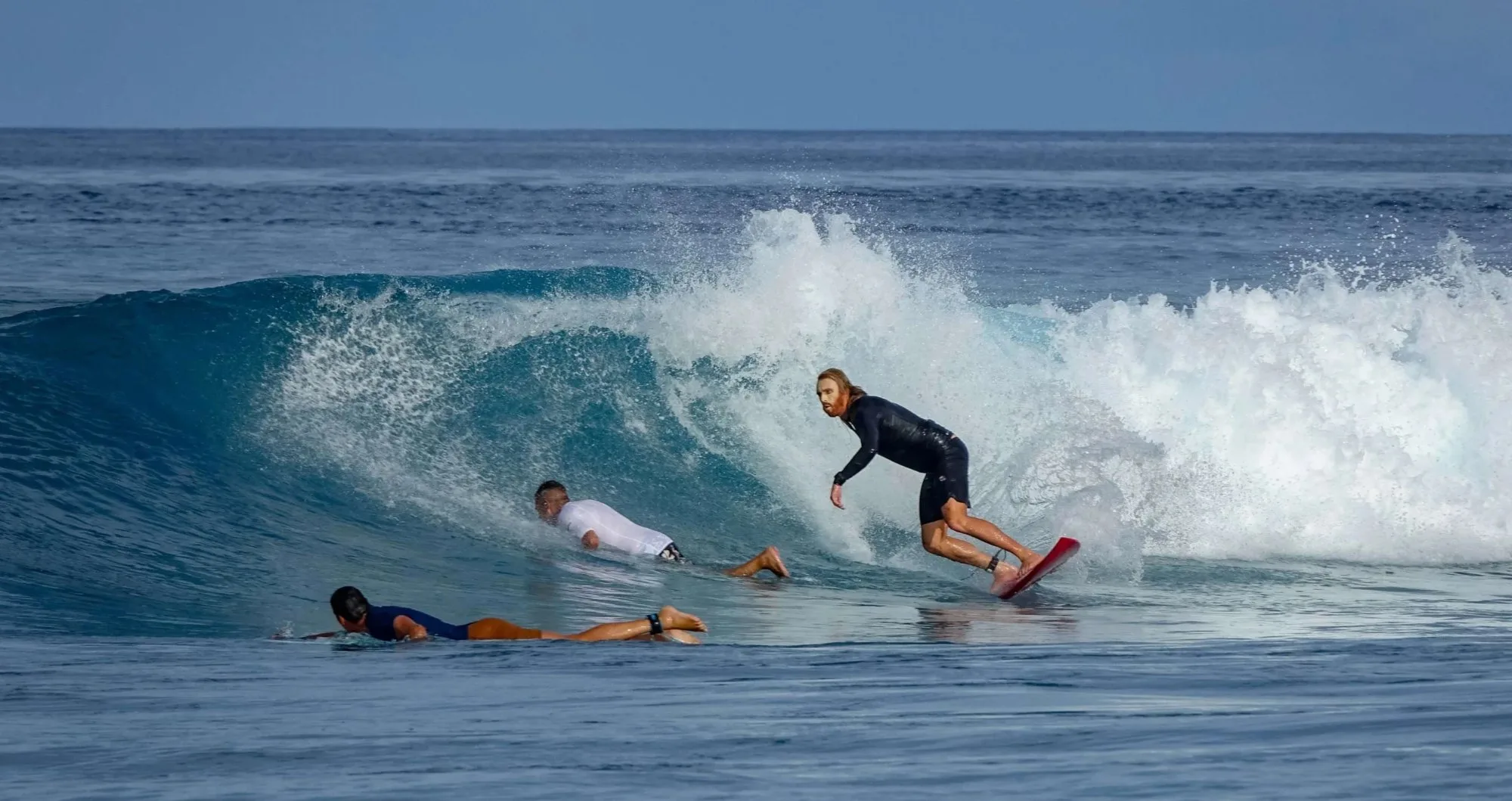 Journal
Surf travel
How we choose the places on Salt Atlas
The thinking behind the stays and charters in the atlas.
Read more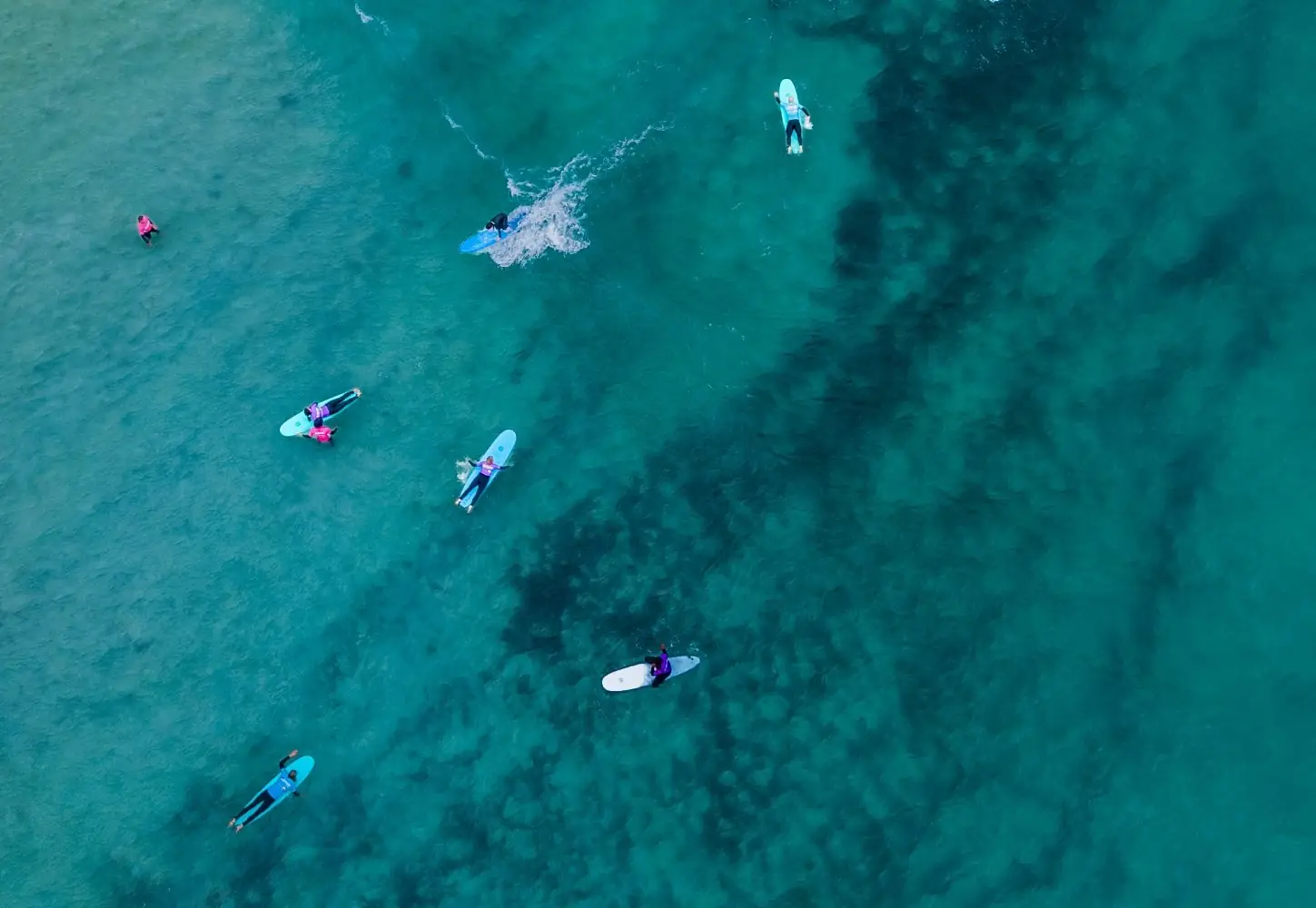 Journal
Surf travel
How to plan a surf trip
A practical guide to working out where to surf next.
Read moreSources
Written by Salt Atlas. Checked November 2026.
- Barlow et al. (2014). The effect of wave conditions and surfer ability on performance and the physiological response of recreational surfers. Journal of Strength and Conditioning Research 28(10): 2946-2953. Full text.
- Berridge & Kringelbach (2015). Pleasure systems in the brain. Neuron 86(3): 646-664. PubMed.
- Berridge & Robinson (1998). What is the role of dopamine in reward: hedonic impact, reward learning, or incentive salience?. Brain Research Reviews 28(3): 309-369. PubMed.
- Boecker et al. (2008). The runner’s high: opioidergic mechanisms in the human brain. Cerebral Cortex 18(11): 2523-2531. PubMed.
- Brymer & Schweitzer (2013). The search for freedom in extreme sports: a phenomenological exploration. Psychology of Sport and Exercise 14(6): 865-873. DOI.
- Farley, Harris & Kilding (2012). Physiological demands of competitive surfing. Journal of Strength and Conditioning Research 26(7): 1887-1896. PubMed.
- Fiorillo, Tobler & Schultz (2003). Discrete coding of reward probability and uncertainty by dopamine neurons. Science 299(5614): 1898-1902. PubMed.
- Fong, Zaleski & Leach (2015). The challenge-skill balance and antecedents of flow: a meta-analytic investigation. Journal of Positive Psychology 10(5): 425-446. DOI.
- Fuss et al. (2015). A runner’s high depends on cannabinoid receptors in mice. PNAS 112(42): 13105-13108. PubMed.
- Hochman & Erev (2013). The partial-reinforcement extinction effect and the contingent-sampling hypothesis. Psychonomic Bulletin & Review 20(6): 1336-1342. PubMed.
- Marques et al. (2021). Bidirectional association between physical activity and dopamine across adulthood: a systematic review. Brain Sciences 11(7): 829. PubMed.
- Mendez-Villanueva, Bishop & Hamer (2006). Activity profile of world-class professional surfers during competition: a case study. Journal of Strength and Conditioning Research 20(3): 477-482. PubMed.
- Merriam-Webster, dictionary entry for “stoked”. Merriam-Webster.
- Niv, Duff & Dayan (2005). Dopamine, uncertainty and TD learning. Behavioral and Brain Functions 1: 6. PubMed.
- Partington, Partington & Olivier (2009). The dark side of flow: a qualitative study of dependence in big wave surfing. The Sport Psychologist 23(2): 170-185. DOI.
- PubMed title searches for surfing with dopamine, endocannabinoid, anandamide and endorphin, run 18 November 2026. PubMed.
- Raichlen et al. (2012). Wired to run: exercise-induced endocannabinoid signaling in humans and cursorial mammals with implications for the runner’s high. Journal of Experimental Biology 215(8): 1331-1336. PubMed.
- Raichlen et al. (2013). Exercise-induced endocannabinoid signaling is modulated by intensity. European Journal of Applied Physiology 113(4): 869-875. PubMed.
- Schultz (2016). Dopamine reward prediction error coding. Dialogues in Clinical Neuroscience 18(1): 23-32. PubMed.
- Secomb, Sheppard & Dascombe (2015). Time-motion analysis of a 2-hour surfing training session. International Journal of Sports Physiology and Performance 10(1): 17-22. PubMed.
- Sidorová (2020). Psychological phenomena and surfing: personal characteristics, life satisfaction and flow experience in Czech and Slovak surfers. Kinesiologia Slovenica 26(2): 35-48. Full text.
- Siebers, Biedermann, Bindila, Lutz & Fuss (2021). Exercise-induced euphoria and anxiolysis do not depend on endogenous opioids in humans. Psychoneuroendocrinology 126: 105173. PubMed.
- Swann, Keegan, Piggott & Crust (2012). A systematic review of the experience, occurrence, and controllability of flow states in elite sport. Psychology of Sport and Exercise 13(6): 807-819. Full text.
- Ulrich, Keller, Hoenig, Waller & Grön (2014). Neural correlates of experimentally induced flow experiences. NeuroImage 86: 194-202. PubMed.
- Wang et al. (2000). PET studies of the effects of aerobic exercise on human striatal dopamine release. Journal of Nuclear Medicine 41(8): 1352-1356. PubMed.
- Winter et al. (2012). Vestibular stimulation on a motion-simulator impacts on mood states. Frontiers in Psychology 3: 499. PubMed.