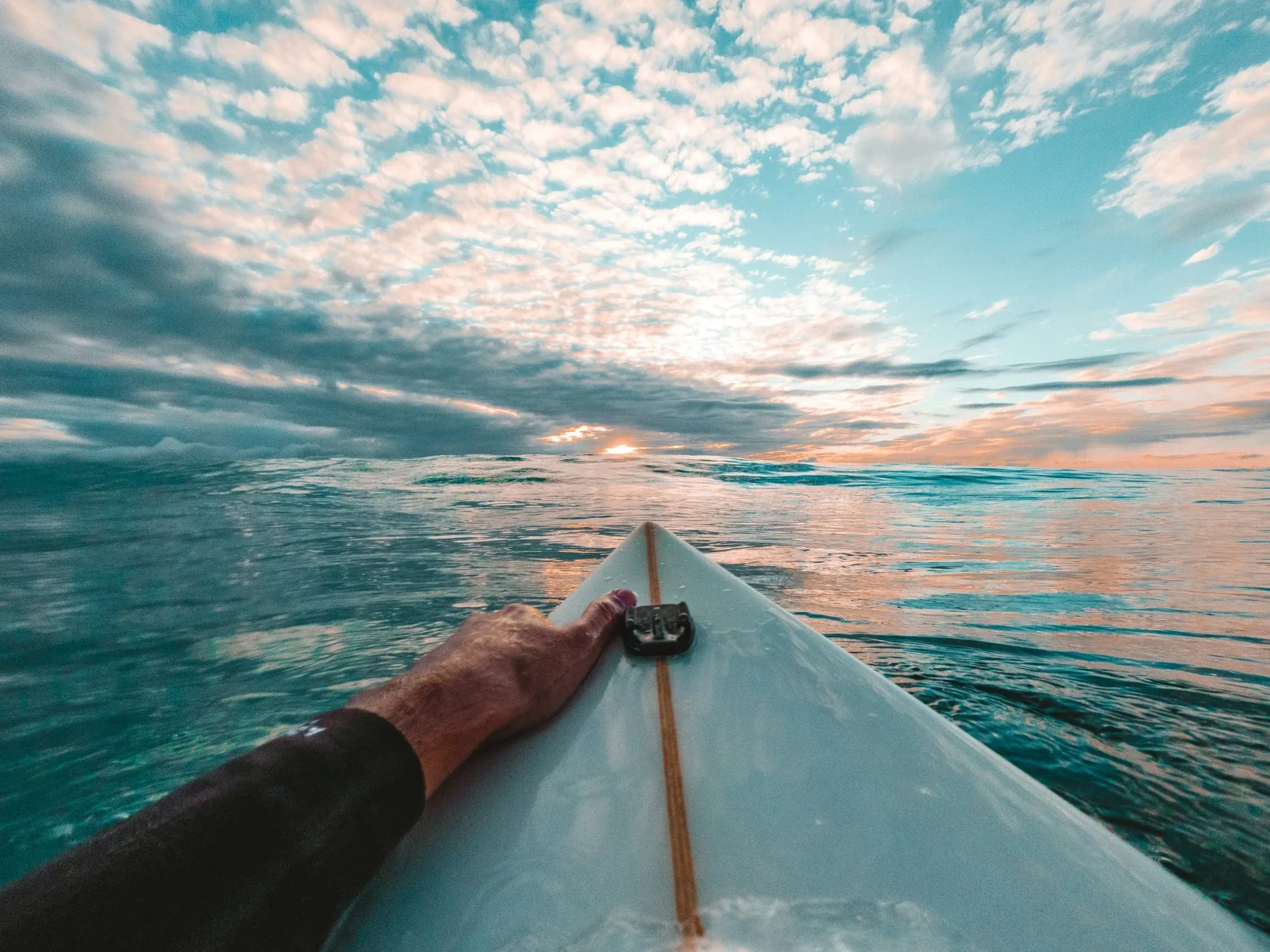
Journal · Ocean & wellbeing
The three-day effect: how long should a surf holiday be?
The three-day effect suggests that a few days in nature can change how your mind works. It is an appealing idea on thin evidence, and the research on holiday length turns out to be more interesting.
On the morning of their fourth day in the wilderness, a group of people on Outward Bound expeditions sat a creativity test and averaged 6.08 out of 10. A separate group, tested before setting out, had averaged 4.14.
That gap, published in 2012, sits at the centre of what has come to be known as the three-day effect in nature: the idea that several days outdoors leave you thinking more clearly and more creatively. It has an obvious appeal if you are trying to justify extra leave to your manager.
It also comes with problems. Nobody in that study was tested twice, the two groups were a decade apart in average age, and day three was never examined as a turning point. The question of how long you should go away for has better evidence behind it, though the evidence does not agree with itself.
The short answer. No study we could find tests day three as a threshold, and research has not settled the ideal length of a holiday. One self-report study of 54 people found wellbeing peaked around day eight, recent meta-analyses conflict on whether length matters, and breaks of four or five days help too. What you do with the time may matter as much as the number of days.
The idea
What is the three-day effect in nature?
The nickname is linked to David Strayer, a psychologist at the University of Utah. A 2017 piece by the journalist Florence Williams credits him with starting to call it the three-day effect. That is a popular account, and the phrase is a nickname, not a measured finding.
The study most often attached to it is Atchley, Strayer and Atchley’s 2012 paper. It involved 56 adults, 26 of them women: 24 took the test before setting off and 32 took it on day four. The authors reported a 50% advantage for the group already out in the wild.
Since no individual was measured before and after, nobody can be said to have improved by 50%, or by anything. The pre-departure group averaged 34 years old and the in-the-field group 24. Age affected scores, so the researchers adjusted for it statistically, which helps without fully answering the question. They also said plainly that they could not separate the effect of nature from the effect of less technology, or from anything else about the expedition.
Day four, meanwhile, was simply when the test took place. The study compared two different groups at one point in time, so it cannot show that something switches on at day three, or that day two or day six would have looked any different.
Later brain studies add intrigue without closing the case. Hopman and colleagues recorded 29 people on a four-day outing at Bluff, Utah, analysing between 22 and 28 of them, and found resting posterior alpha power was lower during the outing than before or after it. They suggested it might be a biomarker, and pointed out that they had no comparison group in a non-natural setting. A registered test by LoTemplio and colleagues in 2020 then went the opposite way to expectations: time in nature increased a brain signal linked to error monitoring.
All of this happened on land, so applying it to a week on a boat is an extrapolation. For what natural settings may do for a tired mind more broadly, read why the ocean calms your brain.
Length
How long should a holiday be?
The most quoted number here is eight. In a study published in 2013, de Bloom, Geurts and Kompier followed 54 employees on long summer holidays averaging 23 days. Health and wellbeing rose quickly, peaked on the eighth day and were back to baseline within the first week at work.
It is a neat result from limited data: 54 people, reporting on themselves, three or four times per holiday. Treat it as a finding from about a week in, in one small study, and resist calling it the perfect length. The same paper found that holiday length was only weakly associated with wellbeing. Passive activities, pleasure, relaxation, savouring, control and sleep showed the strong links.
The meta-analyses disagree
Pooling studies should settle this. So far it has produced a stand-off.
In 2023, Speth, Wendsche and Wegge combined 13 studies and 1,428 people, on holidays of 4 to 23 days. Holidays improved wellbeing by a modest amount, the gains had gone after the first week back, and length made no difference. The authors favoured regular short breaks.
In 2025, Grant, Buchanan and Shockley analysed 32 studies and 256 effect sizes and reached a sunnier conclusion. They found a large effect on wellbeing that faded more slowly than previously thought, and length did moderate the effect. The abstract we read does not say how much length matters, so it cannot be used to argue for any particular number of days.
Shorter breaks also help
Anyone with four days of leave can relax. When de Bloom’s team studied 80 workers on holidays of four to five days, health and wellbeing improved by a respectable margin, though the effect faded quickly.
Fading shows up again and again. An early meta-analysis of seven studies, led by de Bloom in 2009, found gains followed by fade-out after the return to work. In a quasi-experiment with 76 clerks, Westman and Eden saw burnout return within three weeks. Grant’s slower fade is the main note of optimism.
Settling in
How long does it take to relax on holiday?
There is no agreed figure, but the opening stretch is rarely the high point. In a study of 481 international tourists in the Netherlands, Nawijn found that mood was somewhat lower during the first 10% of a holiday and highest in the core phase. Those tourists were not necessarily long-haul, so our suggestion that a big flight makes the slow start worse is inference. The body-clock side of that is covered in why you sleep so well on a surf holiday.
Psychologists tend to look at what recovery consists of. Sonnentag and Fritz, validating a questionnaire on a total of 930 people in 2007, described four distinct experiences: psychological detachment from work, relaxation, mastery and control. A study of 221 university employees by Fritz and Sonnentag found that experiences during a break, a set that included relaxation and mastery, predicted some wellbeing and performance measures afterwards.
Detachment has an unlikely champion in the army reserve. Etzion, Eden and Lapidot compared 81 reservists called away from their jobs with 81 matched controls in 1998. Job stress and burnout fell among the reservists, especially those who mentally detached from work and rated their service positively. Few people would book military service as a getaway, which makes the result more striking.
In Grant’s 2025 analysis, psychological detachment and physical activity also appeared to be the most beneficial parts of a holiday. Surfing looks like a strong candidate on both counts, and it fits the definition of mastery rather well, being a hard skill you get to fail at in public. That is our inference. We found no study testing surfing in this framework.
An active holiday carries no guarantee. After winter sports holidays, de Bloom’s team found that 60% of 96 workers improved substantially, 23% saw no effect and 17% got worse, with passive activities and negative incidents linked to poorer outcomes.
Switching off
Does a digital detox work?
The strongest recent test we found comes from Castelo and colleagues, who in 2025 ran a preregistered randomised crossover trial with 467 American and Canadian iPhone users, average age 32. Blocking mobile internet for two weeks improved wellbeing, mental health and sustained attention. People spent more time socialising in person, exercising and in nature, and average screen time in the first group fell from 314 to 161 minutes a day.
The participants were being paid, and only 119 of them, about one in four, managed to comply. They were also living normal lives, so the trial says nothing direct about holidays.
The wider picture is mixed. A systematic review by Radtke and colleagues, covering 21 studies and 3,625 participants, found benefits in some studies and no effect or negative effects in others. Going fully offline may be unnecessary too: in an experiment with 278 employees in Germany, Brailovskaia and colleagues found that cutting non-work smartphone use by one hour a day for a week improved work satisfaction, work-life balance and positive mental health.
Is your phone draining your brain?
You may have heard that a phone saps your mental capacity just by being nearby. That idea, known as brain drain, comes from two experiments published by Ward and colleagues in 2017. When Ruiz Pardo and Minda repeated the second experiment in a preregistered replication in 2022, phone location had no effect on either task.
Pooled results are still arguing. Parry’s 2023 meta-analysis found a significant effect only for working memory, smaller than theorised, in a field with weak statistical power. A separate analysis of 22 studies by Böttger and colleagues, which pooled phone use and phone presence together, found an overall negative effect. Leaving your phone in the cabin may be pleasant, but this is shaky ground for claiming it will make you cleverer.
The wifi on the boat
Surf charters can no longer be assumed to be out of reach. At the time of writing (November 2026), at least one Mentawai charter advertises unlimited Starlink, while another boat’s listing mentions only a satellite phone for emergencies. We found no reliable data on how many boats have connected.
A boat with no signal would solve the compliance problem that defeated most of Castelo’s volunteers, although that is our inference and it holds only where the boat is truly offline. Where there is wifi, disconnecting becomes a decision you have to make yourself. If that matters to you, ask before you book, and if you are still deciding how to base yourself, our guide to Mentawai boats versus land camps is a good place to start.
Time
Why does time go so fast on holiday?
The writer Claudia Hammond calls it the holiday paradox: the days fly by while you are there, yet the holiday feels long when you look back, because all those new memories stretch it out in hindsight.
Lab and field work points the same way. Across four experiments and two field studies that included holidaymakers, Avni-Babad and Ritov found that time spent on routine tasks was remembered as shorter than non-routine time. The pattern reversed when people judged time as it passed. Zauberman and colleagues, in three studies, found that related events in the intervening period made an earlier event feel further away.
A surf holiday, full of unfamiliar breaks and new faces, fits those conditions well, though we found no direct test of one.
For the outer limits of this, consider Stetson, Fiesta and Eagleman, who in 2007 dropped volunteers 31 metres into a net with a flickering number strapped to their wrists. The fall lasted 2.49 seconds. Asked afterwards, people estimated their own fall as 36% longer than a fall they had watched someone else take, but they could not perceive faster visual detail, and the authors suggested that the stretching comes from memory. Anyone who has surfaced from a long wipeout convinced it lasted a fortnight may recognise the feeling, although that comparison is only an analogy. Emotion matters as well: among 76 novice tandem skydivers, Campbell and Bryant linked more fear with time feeling slow and more excitement with time passing quickly.
The verdict
So how long should a surf holiday be?
No study can give you a number, so what follows is our opinion, built on the research above.
If you are flying a long way, a week or more on the ground makes sense. Slow starts have been reported, and the one measured peak we found arrived about a week in, small as that study was. Beyond that, we would worry less about the count and more about how much of your time is truly away from work.
If you can only get four or five days, go anyway. Short breaks have evidence on their side, and since most studies find the benefits fade within weeks, a second break later in the year could be a better use of your leave than stretching a single one, which is the direction Speth’s team leaned.
A note on the evidence. Many holiday studies rely on self-report and small samples. We found no peer-reviewed study comparing holidays of different lengths to look for a day-three threshold, none comparing a boat with a land-based stay, and none of wellbeing on adult surf charters. Links between surfing, boats and recovery in this article are our inference.
FAQ
Common questions
Is the three-day effect real?
It is a nickname for a promising idea and has not been established as a measurable threshold. Small studies suggest that several days outdoors may change thinking and brain activity, but they cannot isolate nature as the cause or pin the change to a particular day.
Is eight days the best length for a holiday?
Eight days is too precise a target for the data behind it. It reflects when wellbeing happened to peak in one modest group of employees, and larger analyses have since reached opposing conclusions about whether extra days add anything.
Is a long weekend of surfing worth it?
Yes, if that is the time you have. Research on breaks of four to five days found real gains in wellbeing, and they are easier to repeat through the year. Expect the glow to be short-lived, as it tends to be after holidays of any length.
Do surf charters have wifi?
Some do and some do not, and it is changing. Check with the boat before you travel, then decide for yourself how connected you want to be.
Where to go next
Three charters to test the theory on
Time on the water to run your own experiment, and worth asking about connectivity before you go.
Keep reading
More from the journal
 Journal
Surf science
Why you sleep so well on a surf holiday
Light, rocking bunks, post-surf beers and jet lag, with the evidence checked.
Read more Journal
Ocean & wellbeing
Cold water, clear head: what the evidence really says
What cold water may do for your mood, and what changes once you zip up a wetsuit.
Read more Journal
Big waves
The women who changed big-wave surfing
The pioneers and record-setters who reshaped surfing’s heaviest arenas.
Read moreSources
Written by Salt Atlas. Checked November 2026.
- Williams F (2017), REI Uncommon Path (popular account, not peer reviewed). REI.
- Atchley RA, Strayer DL, Atchley P (2012). Creativity in the wild: improving creative reasoning through immersion in natural settings. PLOS ONE 7(12):e51474. PMC full text | PubMed.
- Hopman RJ et al. (2020). Resting-state posterior alpha power changes with prolonged exposure in a natural environment. Cognitive Research: Principles and Implications 5(1):51. PMC full text | PubMed.
- LoTemplio SB et al. (2020). Nature as a potential modulator of the error-related negativity: A registered report. International Journal of Psychophysiology 156:49-59. PubMed.
- de Bloom J, Geurts SAE, Kompier MAJ (2013, online 2012). Vacation (after-) effects on employee health and well-being, and the role of vacation activities, experiences and sleep. Journal of Happiness Studies 14(2):613-633. DOI.
- Speth F, Wendsche J, Wegge J (2023). We continue to recover through vacation! European Psychologist 28(4):274-287. DOI.
- Grant RS, Buchanan BE, Shockley KM (2025). I need a vacation: A meta-analysis of vacation and employee well-being. Journal of Applied Psychology 110(7):887-905. DOI.
- de Bloom J, Geurts SAE, Kompier MAJ (2012, online 2011). Effects of short vacations, vacation activities and experiences on employee health and well-being. Stress and Health 28(4):305-318. DOI.
- de Bloom J et al. (2009). Do we recover from vacation? Meta-analysis of vacation effects on health and well-being. Journal of Occupational Health 51(1):13-25. J-STAGE.
- Westman M, Eden D (1997). Effects of a respite from work on burnout: vacation relief and fade-out. Journal of Applied Psychology 82(4):516-527. PubMed.
- Nawijn J (2010, online 2009). The holiday happiness curve: a preliminary investigation into mood during a holiday abroad. International Journal of Tourism Research 12(3):281-290. Repository record.
- Sonnentag S, Fritz C (2007). The Recovery Experience Questionnaire: development and validation of a measure for assessing recuperation and unwinding from work. Journal of Occupational Health Psychology 12(3):204-221. PubMed.
- Fritz C, Sonnentag S (2006). Recovery, well-being, and performance-related outcomes: the role of workload and vacation experiences. Journal of Applied Psychology 91(4):936-945. PubMed.
- Etzion D, Eden D, Lapidot Y (1998). Relief from job stressors and burnout: reserve service as a respite. Journal of Applied Psychology 83(4):577-585. PubMed.
- de Bloom J et al. (2011). How does a vacation from work affect employee health and well-being? Psychology & Health 26(12):1606-1622. PubMed.
- Castelo N et al. (2025). Blocking mobile internet on smartphones improves sustained attention, mental health, and subjective well-being. PNAS Nexus 4(2):pgaf017. PMC full text | PubMed.
- Radtke T et al. (2022, online 2021). Digital detox: An effective solution in the smartphone era? A systematic literature review. Mobile Media & Communication 10(2):190-215. DOI.
- Brailovskaia J et al. (2024). Less smartphone and more physical activity for a better work satisfaction, motivation, work-life balance, and mental health: An experimental intervention study. Acta Psychologica 250:104494. PubMed.
- Ward AF et al. (2017). Brain drain: The mere presence of one’s own smartphone reduces available cognitive capacity. Journal of the Association for Consumer Research 2(2):140-154. EconPapers.
- Ruiz Pardo AC, Minda JP (2022). Reexamining the “brain drain” effect: A replication of Ward et al. (2017). Acta Psychologica 230:103717. DOI.
- Parry DA (2024, online 2023). Does the mere presence of a smartphone impact cognitive performance? A meta-analysis of the “brain drain effect”. Media Psychology 27(5):737-762. VU Amsterdam record.
- Böttger T et al. (2023). Does the Brain Drain Effect Really Exist? A Meta-Analysis. Behavioral Sciences 13(9):751. PubMed.
- Commercial surf charter listings describing onboard connectivity, read November 2026. Operators are not named.
- Hammond C, Time Warped, as described in The Marginalian (2013). The Marginalian.
- Avni-Babad D, Ritov I (2003). Routine and the perception of time. Journal of Experimental Psychology: General 132(4):543-550. PubMed.
- Zauberman G et al. (2010). 1995 feels so close yet so far: the effect of event markers on subjective feelings of elapsed time. Psychological Science 21(1):133-139. PubMed.
- Stetson C, Fiesta MP, Eagleman DM (2007). Does time really slow down during a frightening event? PLOS ONE 2(12):e1295. PMC full text | PubMed.
- Campbell LA, Bryant RA (2007). How time flies: a study of novice skydivers. Behaviour Research and Therapy 45(6):1389-1392. PubMed.